Betterment Editors

Meet our writer
Betterment Editors
Betterment’s editorial team draws on decades of combined experience to bring you clear, practical points of view on personal finance, investing, and long-term wealth. Together, we demystify money decisions, help you size up options, and share the knowledge needed to build wealth with confidence and ease.
Articles by Betterment Editors
-
![]()
RIA guide: How to explain tax loss harvesting to clients
RIA guide: How to explain tax loss harvesting to clients Feb 26, 2026 12:00:00 PM Tax loss harvesting can be a confusing topic for clients to understand. This guide gives you simple talking points to help explain it to your clients. Clients having trouble grasping the concept of tax loss harvesting? From a simple one-sentence explainer to details on how Betterment’s automated Tax Loss Harvesting works, we’ve got you covered. Table of Contents: In one sentence: “What is tax loss harvesting?” Five key concepts: The building blocks of tax loss harvesting How does tax loss harvesting work? How Tax Loss Harvesting works with Betterment Advisor Solutions How to answer other tax loss harvesting FAQs Explaining complex financial topics to clients is challenging. You want them to understand but, at the same time, not overwhelm them. This guide can help you explain sophisticated tax strategies to your clients without causing extra stress for them. In one sentence: “What is tax loss harvesting?” So, your client asks: “What is tax loss harvesting?” Rather than delivering a complex answer, start with a single sentence: “Tax loss harvesting aims to lower your tax bill by selling investments at a loss to offset capital gains from other investments.” Now, stop there. Ask your client if they want you to break down the details of how it works. If they say yes, start with the five key concepts below. Five key concepts: The building blocks of tax loss harvesting When talking with clients, you can share that these concepts are the building blocks that make tax loss harvesting possible. You can walk through the table below, providing examples to clients. How does tax loss harvesting work? Now that you have explained what tax loss harvesting is in one sentence and shared the five building blocks, you can explain to your client how the process generally works in three steps. Step 1: Identity your capital losses This involves looking for investments in your portfolio that have declined since they were purchased. It’s important to note that we don’t sell any investment that is down in value. We strategically select which investments to sell to help maintain the proper portfolio allocation. Step 2: Sell at a loss and replace your investment Once investments with capital losses have been identified, they are sold to “harvest” the loss. Making sure not to break the “wash sale” rule, new investments are bought to fit into your overall investment strategy. Step 3: Use loss to offset your capital gains or income on your taxes The losses you “harvested” can offset up to $3,000 of capital gains from investments or income each year. Any remaining losses over $3,000 can be carried forward indefinitely to offset gains or income in future years. How Tax Loss Harvesting works with Betterment Advisor Solutions It’s important to let your clients know that this is the general process for implementing. Performed manually, it can be time-consuming and potentially risky if done improperly. However, leveraging modern technology, like the Betterment Advisor Solutions platform, can help you minimize risk. As a Betterment advisor, you can offer your clients Tax Loss Harvesting (aka TLH). Read the full TLH white paper. Here’s how to talk to your clients about Betterment’s TLH process As an advisor, you can use the following talking points: No extra costs: There are no extra trading costs to harvest your losses, so you don’t have to worry if extra fees reduce any potential gains. Automated dividend reinvestments: Without breaking the “wash sale” rule, available dividends are reinvested rather than held as cash, which allows you to keep your money in the market so you don’t miss out on potential gains. Automatic rebalancing: When shares are sold at a loss, the proceeds are reinvested in the asset classes that will bring your portfolio back into balance rather than simply defaulting back to the asset class they came from. No short-term capital gains tax: Some tax loss harvesting methods switch back to the primary ETF after the 30-day wash period has passed. This can create short-term capital gains tax that may dramatically reduce the benefit of harvesting losses and even leave you owing more in taxes. Our algorithm only moves back to the primary ETF when it is appropriate for your account. IRA harvest protection: Selling an ETF for a loss in your taxable account and then buying the same ETF in your IRA can cause a permanent wash sale, destroying the benefit of loss harvesting entirely. We strive to ensure that IRA deposits do not undermine a harvest. How to answer other tax loss harvesting FAQs Below are common questions about tax loss harvesting, along with talking points to help you respond to clients within the context of Betterment’s TLH. Is tax loss harvesting right for me? Tax loss harvesting might be right for you if you are in a higher tax bracket or have significant capital gains or losses in a taxable account. In both scenarios, tax loss harvesting may offset your capital gains to help reduce your tax bill. Using Betterment’s automated technology, we can help harvest losses in a way that reduces potential risks. What are the risks of tax loss harvesting? Risks can include extra trading fees, holding too much cash after selling at a loss, an unbalanced portfolio, or violating the wash sale rule. But don’t worry — our tech is designed to help avoid these risks so you can enjoy the benefits of tax loss harvesting. What are the benefits of tax loss harvesting? The primary benefit of tax loss harvesting can be reducing your tax bill. When done correctly using our automated technology, Betterment can lower the tax you would have paid on your capital gains. What if I have more than $3,000 in losses? You can carry forward any unused losses into future years. For example, if you have $5,000 in losses and use $3,000 to offset capital gains this year, you can carry forward $2,000 to offset capital gains or income in any future year. Can I wait until tax day to sell at a loss? No, unfortunately, tax loss harvesting transactions must be complete by December 31 each year. Can I use tax loss harvesting with any of my investment accounts? Tax loss harvesting can only be used in taxable accounts. In tax-advantaged accounts, like a 401(k), you can’t deduct the losses, so tax loss harvesting wouldn’t be applicable. It’s important to note that selling an asset at a loss in a taxable account can still trigger the wash-sale rule if you purchase the same or a substantially similar asset within 30 days in a tax-deferred account, such as a Roth IRA. For instance, selling an ETF at a loss in a brokerage account and then buying the identical ETF within 30 days in a Roth IRA could still disallow the loss for tax purposes. See how Betterment automates tax loss harvesting and more From our proprietary Tax Loss Harvesting process to tax-smart investing portfolios, the Betterment Advisors Solutions platform streamlines your firm’s practices while creating value for your clients. -
![]()
Going independent: 4 key questions before starting your own RIA
Going independent: 4 key questions before starting your own RIA Feb 25, 2026 10:00:00 AM Thinking of breaking away to become an independent RIA? Ask yourself these four key questions first to help set your new firm up for success. The data looks promising if you’re looking to start an independent RIA… In 2024, PlanAdviser reported that the average Millennial who works with a financial advisor started looking for advice at age 29. That’s nine years younger than Generation X and 20 years younger than Baby Boomers. The great wealth transfer is now projected to be $124 trillion, and the population of Millennials in the U.S. hovers over 72 million people. There may have never been a better time to start an independent RIA looking to serve a growing high-net-worth market with demand for financial advice. But starting your own firm is a big undertaking–and a daunting one. Building your confidence starts with thinking through important facets of your plan. So, it’s important to think about what matters most to you. Below, we’ve laid out four key questions, as well as a business plan, to help you build a solid foundation for your firm. Question 1: Who do you need to support your firm? As you start an independent RIA, establishing strategic professional partnerships can help ensure you have the necessary resources and expertise to navigate the transition smoothly. These partnerships provide critical support in areas like compliance, technology, and operations, enabling you to set up a strong foundation for your practice from day one. You’ll likely need support from some, if not all, of the following professionals: Attorney: Throughout the transition, your legal counsel can offer valuable guidance, like reviewing your existing non-compete agreements with your current employer, helping you establish a business entity, and providing overall protection for your interests. Attorneys are a key resource, who can offer expertise on how to register a new business, for example. Online legal solutions can also be a solution if costs are a concern early on. Tax advisor: Having a tax advisor from the outset of going independent can be beneficial in addressing any tax-related questions or concerns that may arise. Thorough tax planning can help your firm remain in compliance and reduce your tax liability as you start a business. For example, your firm may qualify for tax credits available to new businesses. A tax advisor can help you claim all credits and deductions that you may not have known to be available to you. Compliance consultant: As an independent RIA, you will be required to have a Chief Compliance Officer (CCO) to oversee and ensure the firm's adherence to regulatory requirements. You can take on this role yourself, appoint an employee, or outsource the responsibility to a compliance consultant. Outsourcing the CCO function can be particularly beneficial during the registration phase, as it allows you to leverage the expertise of a seasoned professional, saving you valuable time. For example, a CCO can help with filing Form ADV and related documents, navigating SEC or state registration requirements, drafting tailored compliance policies, transition planning, and setting up necessary systems for recordkeeping and reporting. Marketing agency or freelancer: A polished brand is a key ingredient in ensuring prospective clients view you as a trusted, professional firm. A skilled marketing consultant or agency can help you develop a strong brand identity, create effective marketing strategies, and establish a differentiated brand presence. Services they provide can include website design, social media management, content creation, and lead-generation campaigns. Other RIAs: While you may not want to talk with direct competitors, seeking guidance from fellow RIAs who have successfully navigated the transition to independence can be valuable. By consulting with peers who have started their own RIAs, you can gain valuable insights and advice, which can help increase your confidence and better prepare you for potential challenges. If possible, speaking with RIAs who have made the transition from your current firm can provide particularly relevant and nuanced guidance, as they will have firsthand experience with the unique circumstances and obstacles you may face. We’re here to support you, too. At Betterment Advisor Solutions, we take pride in guiding advisors who are, looking to break out on their own. We provide 1:1 support as you start your firm. Have questions? Talk to us today. Question 2: Where is your time best spent running your firm? When you’re first starting your firm, you’ll quickly find yourself wearing many hats. It’s important to understand your bandwidth and the key actions you need to take to build a successful independent RIA. For example, if you have few clients when you start, then business development, client experience, and business processes will likely require more of your time as you focus on growing your book. As more clients come onboard, your priorities will shift. Once you have a healthy book of clients, you’ll need to evaluate which activities are most valuable to your firm. For example, should you spend your time on investment management and portfolio construction? Or would it be better to outsource these tasks, and devote more time to clients and holistic financial planning? Review the following common activities, and prioritize those you feel are most important for your firm’s success: Business development: Attracting and acquiring new clients to grow your business Client transition and onboarding: Establishing a clear process for account setup and communication, including setting up client households and opening as many different accounts as needed Client experience: Delivering exceptional service and building strong relationships with existing clients and identifying opportunities to offer additional services, like tax or estate planning Business processes: Managing the operational aspects of your firm, such as compliance, marketing, and technology Wealth management: Providing holistic financial guidance tailored to clients' goals, such as retirement, education, and charitable giving Portfolio management: Developing and implementing investment strategies tailored to each client's unique needs and goals In our 2025 Advisor Survey, we found most advisors spend the majority of their time on financial planning. You can use the data below as a benchmark to compare how you spend time, but keep in mind the additional needs of your firm as you start the process of going independent. Question 3: What will your RIA tech stack look like? The term “tech stack” simply refers to the collection of software platforms and tools that you use to do business—and deciding what it looks like is one of the most important decisions for your new firm. Your tech stack can make or break your firm’s efficiency and the quality of service you provide to clients. It will include many different and often integrated software, but at the end of the day, it should be driven by this question: “How do I need to spend my time?” For example, you’ll likely want CRM (customer relationship management) software to track and manage all of your client data and interactions in one place. Without CRM, you’ll spend time manually tracking client engagements in spreadsheets, taking away time from serving clients. The four essential components of an RIA tech stack A comprehensive tech stack for independent RIAs should include the following four essential pieces of software. Custodial solution: Selecting a custodian is one of the most significant decisions for your firm. Your custodian is responsible for the safekeeping of the assets, processing transactions, and providing administrative support. Look for a custodian with strong tech capabilities for you and your clients—and the ability to integrate with your broader tech stack. Portfolio management: These technologies enable you to efficiently and effectively manage your clients' investments. The right portfolio management platform can range from providing simple model marketplaces to full-end-to-end tooling, including tax-optimization technologies, portfolio customization options, and more. Some custodians offer built-in portfolio management software, which can help your firm cut costs and streamline your operations. Financial planning: Financial planning technologies allow you to create comprehensive, customized financial plans to help clients budget, set goals, and plan for taxes. Many financial planning platforms integrate with custody software and customer relationship management (CRM) software, enabling a seamless and holistic approach to client service. CRM: CRM software is essential for managing client communications, collaborating with your team, and building long-term relationships with clients. A good CRM should be able to integrate client data from multiple systems and integrate with marketing automation technologies to track your client information and potentially send, or at least enable, personalized communications. Additional tools to support your firm's operations To run an efficient and effective firm, you may also require other tools, which can range from free platforms to robust solutions. Some of these tools you may wish to consider include: Compliance software: Compliance software covers a range of solutions, from simple archiving of firm communications to advanced cybersecurity strategies. In addition to software, your firm may require compliance consulting services, which can be provided by the software vendor or a separate third party. Accounting software: Manages your firm's finances, tracks expenses, and generates invoices. Billing software: As you sign clients, you’ll want to make sure you have billing software that integrates with your tech stack. Betterment’s fully integrated billing solution lets you set a fee schedule for each household during onboarding and automate collection and reporting. Marketing software: Automates marketing campaigns, manages social media, and tracks lead generation. Scheduling software: Streamlines client meetings, appointments, and communications. Video conferencing software: Facilitates remote meetings and collaborations with clients and team members. File management software: Securely stores and manages client documents, contracts, and other sensitive information. AI notetaking software: Automates note-taking, transcription, and data entry, freeing up more time for high-value tasks. As you review different software solutions, we can’t stress enough the need to look for platforms that integrate with each other. By carefully selecting and integrating these tools, you can build a robust tech stack that supports your firm's growth, efficiency, and ability to deliver exceptional services to clients. With Betterment Advisor Solutions, you’ll get a vertically-integrated product that combines custody with your most critical practice software, including onboarding, trading (or portfolio management), reporting, and billing. We recommend reviewing your tech stack on an annual basis to ensure it remains aligned with your firm's evolving needs and goals. Question 4: How will I transition my current clients to my new firm? Your current clients will be your most valuable ones as you start your independent firm. Client onboarding is a crucial phase of going independent. Although you may not be able to discuss your plans to start your own firm just yet, you can begin laying the groundwork for a successful transition. Talk to an attorney: Consulting with your attorney can be a smart move to ensure you're not violating any existing company policies or agreements. If permissible, start compiling a list of clients you'd like to invite to join your new firm. This may include gathering their contact information, such as names, addresses, phone numbers, email addresses, and account titles. Select your clients strategically: As you consider which clients to bring on board, take a strategic approach. Starting your own firm presents an opportunity to specialize in a specific niche or target market. Think carefully about the types of clients you'd like to serve and the services you want to offer. By defining your ideal client profile and target market ahead of time, you'll be better equipped to develop effective marketing and business development strategies when you launch your firm. This clarity will help you hit the ground running, allowing you to focus on building strong relationships with your new clients and growing your business from day one. Bonus: Building your business plan A business plan is not only helpful for you, as you start and manage your own firm, but it’s helpful for any key employees and partners of your firm. For example, a marketing agency or outsourced Chief Compliance Officer can use the information in your business plan to better serve your needs as they provide tailored advice and strategies to help grow your firm. Below is an outline to follow along with some tips for completing each section. Independent RIA business plan outline Executive summary: A brief overview of your RIA firm, its mission, goals, and objectives. Try to clearly explain why your firm exists in two to three sentences. The information in your executive summary can serve as a guiding light for many important stakeholders. For example, for you and your employees, it explains clearly why your firm exists. And for clients and potential clients, the language in this section can be used on your website and in other client communications focused on highlighting your firm’s mission. Company description: A detailed description of your RIA firm, including your history and details on any key employees, the business entity structure, and ownership structure. Writing this section ahead of starting your firm can help you have a clear understanding of steps you may need to take, such as creating an LLC and planning who will serve in key roles at your firm. For example, this section should detail who (internal employees or outsourced consultants) will oversee investment management, technology operations, compliance, and day-to-day operations. Market analysis: An analysis of your firm’s target market, including demographics, financial needs, and trends, as well as a competitive analysis of other RIAs in your market. You can conduct a market analysis yourself or work with a market research agency to assist with more in-depth analysis. If conducting market research yourself, you can leverage free data from the United States Census Bureau or Data Commons and then add paid data sources as needed. Services and products: A description of the investment services and products offered by your firm, including but not limited to portfolio management, financial planning, and other advisory services. Your services and how you price them should align with the needs of your target market defined in your market analysis. For services like financial planning, list out exactly what that will entail for your clients, including services like cash flow management, tax planning, retirement planning, estate planning, and risk management. Being very detailed in this section will allow you and your clients to understand what they are getting from your services. Marketing and sales strategy: A description of your firm’s marketing and sales strategy, including how it will attract and retain clients. One common approach to outlining a marketing strategy is using the “4 Ps” for your firm. The 4Ps help you document Product, Price, Place, and Promotion to help you build a strategy for promoting and distributing your services to the right audience. See our guide for creating a marketing plan using the 4Ps. If you have larger growth plans, this section can also describe your firm’s growth and expansion plans, including its strategies for increasing revenue, expanding its client base, and entering new markets. Operations and management: A description of your firm’s operational structure, including its management team, staff, and technology infrastructure. This section should cover the hardware, software, and network systems needed to run your firm and clearly explain how you plan to integrate your tech stack to run your firm efficiently. Financial projections: Financial projections, including revenue, expenses, and profit projections, as well as a breakdown of your pricing and fee structure. More formally, these projections should be used to create a three-year income, balance, and cash flow statement forecast to help with planning and goal setting. Also, as you transition from your current job to your independent firm, consider the funds you may need to set aside for personal expenses as you start your firm without much or any income. Compliance and risk management: A description of your firm’s compliance and risk management procedures, including its regulatory requirements and internal controls. Risk assessments should be conducted for regulatory compliance, market volatility risk, cybersecurity risk, and other practice areas such as marketing, advisor compensation, and trade execution. Human resources and staffing: A description of your firm’s human resources and staffing plan, including its staffing needs, training programs, and employee benefits. This section will be more straightforward if you run a lean practice, but it's important to clearly define staffing needs and roles if you have additional team members. Betterment Advisor Solutions is your partner for going independent Going independent means wearing a lot of hats as you grow your own firm. With Betterment Advisor Solutions, you get an all-in-one custodial platform that integrates and automates your most essential practice management and portfolio management tasks. From onboarding new clients to performing operational tasks and ongoing portfolio management, our team and technology will help advisors like you get set up with tooling to ensure you can cover many of your bases early on. We support hundreds of RIAs, helping them streamline their practices’ operations and technology. Take Eric, for example… “I run a lean practice—having a solid tech stack is essential to running my business successfully, especially with back office responsibilities. Having a partner like Betterment helps me streamline client onboarding and ongoing investment support so I can focus on other aspects of my business.” —Eric Rodriguez, WealthBuilders Client. Views may not be representative. See G2 reviews. We’re here to answer your questions and be your guide as you set out on your independent RIA journey. Ready to talk? -
![]()
How to set up the Nitrogen integration
How to set up the Nitrogen integration Feb 17, 2026 3:51:46 PM Overview Nitrogen is a leader in AI-enabled, client-facing software for financial advisors. Its integrated platform combines risk alignment, investment planning, tax planning, retirement planning, and proposal generation, helping advisors deliver smarter, more engaging meetings that can win business and build lasting client confidence. Trusted by over 30,000 advisors, Nitrogen’s technology is built to be seen, enabling advisors to swivel their monitor and guide clients through clear, visual insights that keep them invested in their advisor, fearlessly. The information sent to Nitrogen includes: Account information Positions Enabling the integration You can set up this integration for your firm by taking the following steps: Log in to your advisor dashboard and navigate to Settings > Integrations. Select Blueleaf from the list and click Connect to Nitrogen You will see confirmation that the integration has been enabled. Data will be sent to Nitrogen within one business day. Once the data release is confirmed, Nitrogen will complete the final configuration and make the integration available in the application within one additional business day. For more information on how to use this integration in Nitrogen, see this help article. -
![]()
How to set up the Blueleaf integration
How to set up the Blueleaf integration Feb 12, 2026 4:29:36 PM Overview Blueleaf is a complete wealth management platform delivering high-engagement client experiences plus reporting, billing, and rebalancing for firms seeking growth and exceptional delivery for clients. The information sent to Blueleaf includes: Account information Positions Transactions Tax lots Enabling the integration You can set up this integration for your firm by taking the following steps: Log in to your advisor dashboard and navigate to Settings > Integrations. Select Blueleaf from the list and click Connect to Blueleaf. You will see confirmation that the integration has been enabled. Data will be sent to Blueleaf within one business day. Send an email to vipsupport@blueleaf.com to let the Blueleaf support team know that you want to set up an integration with Betterment. -
![]()
Switching custodians: Why Sound Financial transitioned their book to Betterment Advisor Solutions
Switching custodians: Why Sound Financial transitioned their book to Betterment Advisor Solutions Jan 26, 2026 9:15:00 AM A conversation with Cory Shepherd, ChFC®, CFP®, President and Partner Moving to a new custodian is not an easy decision. For this interview, we sat down with Cory Shepherd, President and Partner at Sound Financial Group, to learn how he navigated a decision to switch providers in 2020. Sound Financial was searching for a custodian that could offer something different than the legacy options. They needed a partner that not only met their basic pricing and operational needs, but also complemented their planning philosophy and could set their practice up to scale long term. The team ultimately landed with Betterment Advisor Solutions, a decision that has helped the firm cut overhead costs, streamline onboarding, and invest more time in giving quality, human advice. Moreover, we discover how Sound Financial’s decision to switch to Betterment Advisor Solutions was, in the end, a way to maintain “elegant simplicity” in their lives as independent advisors—giving their team, their clients, and their families more flexibility to pursue their goals. Read the full story below. The path to independence Cory Shepherd, ChFC®, CFP®, is the President and Partner at Sound Financial Group. The fee-based planning firm has three advisors and serves about 300 clients representing $125MM in AUM. Sound Financial’s path to independence was, in some ways, an accident. For years, co-Presidents Paul Adams and Cory Shepherd focused on expanding their team within the broker-dealer model. But a series of contract negotiations with their broker-dealer in 2016 prompted a decision to go independent. “Breaking that relationship was one of the best, ‘bad’ things that could have happened to us. After that, we stopped trying to grow horizontally with as many advisors as possible, and started prioritizing growing vertically.” The move not only changed their business strategy, it changed their perspective on independence and the beauty of deciding for yourself what work looks like. “We have this amazing life with a lot of freedom. We work closely with clients we love and avoid the multilayered requirements of larger corporations.” An action-forward planning philosophy Sound Financial is passionate about creating financial plans that won’t end up collecting dust—both figuratively and literally. “During my early days at MetLife, I was so proud of our financial planning work. We’d create these 80-page, leather-bound, beautiful plans. And then, one day, I found out that a client had wedged one under the leg of their pool table to level it out.” That epiphany underpins Sound Financial’s Wealth Design process: The biggest challenge clients face isn’t creating a financial plan, but implementing it. “If an advisor just hands over a plan document, 9 times out of 10 there will be major breakdowns in implementation.” With an average annual household income range of $250,000 to $1.5MM, the firm’s clients are largely working professionals—physicians, tech executives, and business owners—in the wealth accumulation phase. To emphasize the importance of action for these clients, Cory compares the planning process to an architect designing a house: “An architect’s job is to provide a blueprint that ensures you’re getting the best house for you, the house that will allow you to live your best life. But the design is only worthwhile if you can act on it and actually build the house.” Repapering hurdles prompt a switch Prior to transitioning to Betterment Advisor Solutions, Sound Financial had a positive relationship with their core TAMP. However, an acquisition by another firm in late 2019 prompted a switch. About 8 months into the transition, Sound Financial was surprised to learn they were going to need to repaper the majority of their client accounts. “We honestly weren’t looking to make a move, but, because they were going to make our clients go through the trouble of repapering accounts anyway, we felt it was our responsibility to do some due diligence and see if there was a better fit for them somewhere else.” Searching for a future-forward custodial partner In their search for a new custodian, Sound Financial prioritized price, innovation, and transparency for clients. As a smaller firm, they found it challenging to find a partner that was aligned to their pricing requirements. “Our firm was being charged 42 bps at the time,” Cory noted. “We couldn’t justify the fee, and [our TAMP] wasn’t able to customize it. They didn't want to make that custom, cut-out niche for us and, at the end of the day, we just couldn't make the pricing fit.” Sound Financial also evaluated how various platforms could help improve their back-office and client onboarding experience. At the time, tech stack fragmentation was a challenge. They were layering one-off tools on top of their core systems (TD, Fidelity, and AssetMark) to support account management and opening, which created a disruptive and paper-heavy process. “Back then, it took us an hour just to open a new household’s first account. On top of that, we then needed 20 minutes for each additional account opened, just to manage all the paperwork.” Considering Betterment Advisor Solutions Cory admits he was apprehensive when his business partner first brought up Betterment. “I thought of it as a millennial product for DIYers.” But the custodial platform’s integrated onboarding technology alone piqued his interest. “I’d been embedded in the world I’d grown up in, so it was a little like magic the first time we had a Betterment Advisor Solutions demo. The technology made everything so simple. Even for clients to do it themselves. Click, click, click, and you open an account, even live with a client, in about five minutes. That was huge.” The team also appreciated that the platform adds transparency to the client experience. The planning and projection tools in particular felt like something they could really give to a client. Still, Sound Financial had some reservations and risks to weigh before making the leap. Chief among them: the Betterment brand. “We wondered, Are we going to have to compete against ourselves? Will folks want to leave us and just go to Betterment solo? But that hasn’t happened. In fact, clients who had Betterment accounts already, before they met us, have brought them into our practice.” Making the switch: 90% of assets in 90 days An all-in-one, vertically-integrated custodian, Betterment Advisor Solutions offered Sound Financial something new in their search for a custodian. “As an independent practice, we really liked the fact that Betterment Advisor Solutions was focused on a different kind of value proposition: good technology, ease of communication and workflow, and efficient pricing.” The process of transitioning their client assets was a contrast to the demanding, piecemeal transition they’d made just a few years prior when going independent. “We moved 90% of our client assets within 90 days. It was super fast.” The Sound Financial team expertly navigated client conversations around the transition, emphasizing the improved client experience and technology. “It was an easy conversation to have because there is a lot of value for the client. We discussed the expected time savings, and how we planned to use this time to improve servicing for them. We also focused on the ease of use, the transparency, and being able to do things yourself.” Results Cutting overhead costs and client fees To Betterment Advisor Solutions, Sound Financial noted they have been able to cut their custodial fees by more than 50%, and recapture these savings in the firm’s profitability. They’ve steadily increased growth rates year over year without increasing client fees—even during the turbulent COVID-19 market. Outsourcing investment management increased their team’s capacity, giving the firm greater operational leverage. “The efficiency of the technology is so much higher that we have not had to keep up the hiring pace that we were previously maintaining. With Betterment Advisor Solutions, we could just about double the total number of clients we have and not have to hire another person.” Moreover, efficiencies unlocked in investment management allowed Sound Financial to improve pricing at the top end of their fee grid. “This gives us a clear advantage over competitors in attracting these higher-net-worth clients to work with us.” A boost to employee morale and retention Reducing hiring needs gave Sound Financial an additional, unexpected competitive edge: a happier workforce. “We’re unlocking time and capacity as we grow, and, with fewer hires, we can reward our team members more than our competitors can. Suddenly, employee retention becomes a big bonus—and one that was not as obvious.” Fostering strong employee retention is now a vital part of the firm’s business strategy. “We’re focused on doing what’s right for our team. Too much turnover, and having to frequently introduce clients to a new name on the phone, can start to erode clients’ confidence in your practice.” Future-proofing a practice in an AI-dominated culture Moving to Betterment Advisor Solutions as their core custodian has changed how Cory thinks about growing and sustaining the practice. At first, they believed they could use automation to simply increase the number of clients served—taking on significantly more client accounts, and spreading the team thin across the base. Instead, the team now sees investing more time in each client relationship as their primary path to growth. “What we’ve realized over time is that the technology can give us more time to have a more customer-centric and intimate relationship with a client, and that’s how we want to grow.” Sound Financial believes creating a personal planning experience will help them stay ahead of the curve. “AI is at the forefront of almost every cultural conversation right now, and deepening the human experience for clients is a more valuable and ‘AI-insulated’ model than providing generic advice to the masses. “We don’t want to compete with a mass market, digital approach. We want to use automation to free up our time to grow organically — give clients such an amazing experience that they’re compelled to refer us to people they know. That’s harder for AI to disrupt.” What’s next for Sound Financial The Sound Financial team remains focused on scaling intentionally. They have a successful podcast that they use to reach new clients, and have tested paid mediums for lead generation. But they’re less interested in ramping up an online acquisition model. “I love meeting with someone who cares about someone that I already know and work with, and working with that new connection. A lot of our clients become just like friends and family to us.” Looking forward, Cory sees technology as a means for making daily operations more efficient. “We really value balance. And we want to continue using technology that helps give all of us back time. Time to work with clients and time with our families.” “Our goal is to quietly and intentionally grow the community of people we’re helping, and to use technology to streamline our work as much as possible. All so we can retain this elegant simplicity that we’ve found in our lives.” -
![]()
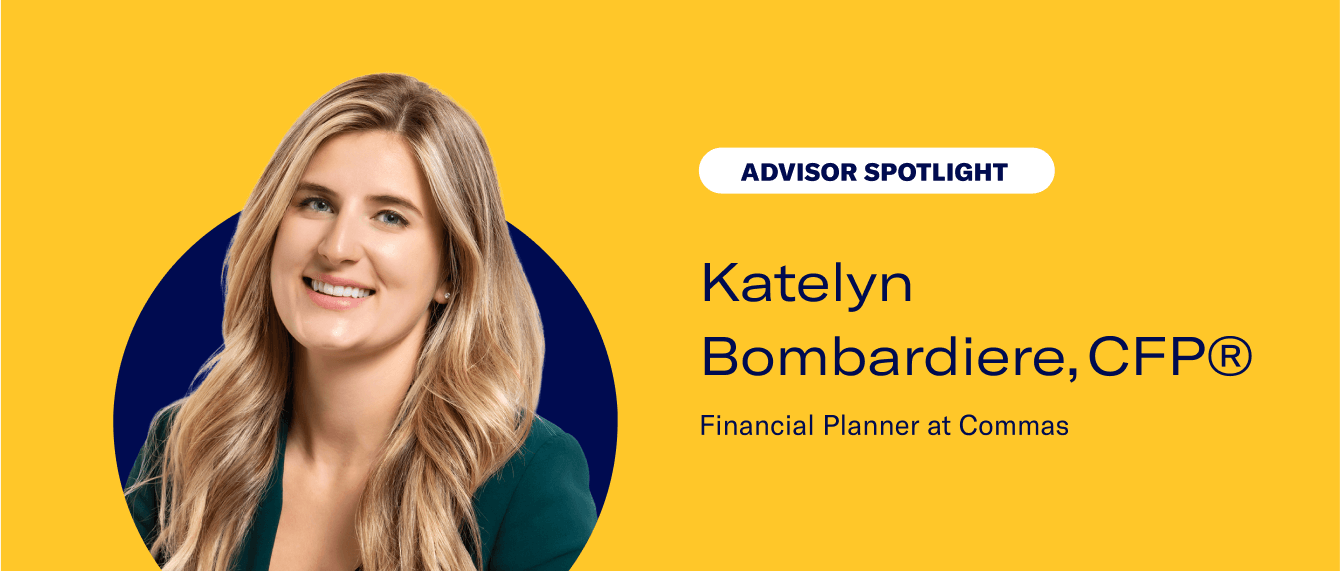
Advisor Spotlight: Katelyn Bombardiere, Commas
Advisor Spotlight: Katelyn Bombardiere, Commas Jan 23, 2026 11:00:00 AM For this Advisor Spotlight, we welcome Katelyn Bombardiere, CFP®, a Financial Planner at Commas, to chat about her passion for helping the everyday investor. Advisor: Katelyn Bombardiere Firm: Commas Bio: Katelyn Bombardiere, CFP®, is a Financial Planner at Commas, a fee-only financial planning firm based in Cincinnati. Katelyn started her career in the high-net-worth wealth management industry where she quickly realized her passion for helping the "everyday" investor. She sought a different approach to help people (like her friends, family and peers) without worrying about asset minimums. Firm Bio: We all don't have millions of dollars—but we all have goals. Commas is a financial advisory that provides fee-only service to the EveryInvestor: those who might not fit the standards set by traditional high-net-worth advisories but still deserve personalized financial guidance to meet their goals. We offer services with no account minimums, working with our clients at every step of the process and empowering them to create, plan, and achieve their desired money goals. We Are: Encouraging: 0% Judgment Trustworthy: Certified, Not Stuffy Purposeful: Fee-only for All Approachable: We Wear Jeans Why did you decide to become an advisor? As a sophomore in college, I was fortunate enough to go on a trip through the Leeds School of Business at The University of Colorado at Boulder. This trip took a group of students to over 10 different financial firms to introduce them to the possibilities of careers in finance. It was on this trip that I declared my major as finance and figured out that I wanted to be a wealth advisor. From there, I pivoted my internship and career choices to pursue my goal of becoming an advisor. What are some questions that you wish more clients would ask, and why? I think it is important for people who are looking for an advisor to know: if the advisor they are talking to is a fiduciary how that advisor is getting paid the investment philosophy and financial planning process the advisor follows what the advisor's qualifications are. I think gauging a sense of the advisor's passion is important too. You want to work with someone who is passionate about what they do, continues to learn, and shows an interest in you. What do you think is the biggest mistake people make with their money? Either they don't save enough, or they save but don't invest. Another big mistake is not understanding the difference between long-term investing in well-diversified funds and day trading. What does your firm's current tech stack look like? How has technology impacted your work? We utilize Betterment Advisor Solutions as our custodian and Right Capital as our financial planning software. We have created our own CRM platform using Airtable which is a zero code cloud spreadsheet database. This tool allows us to customize our own portal where we house client data, tasks, meeting notes, and the client ledger (types of accounts, where they are held, contributions, notes, etc.). What makes Commas unique, however, is our internal automations through Zapier. For example, after our introduction meeting, the prospect is automatically sent an email with the next steps (signing up for our fee, completing a questionnaire and opening a Betterment account with our client agreements). Once they complete that step they are automatically sent another email asking them to upload documents to our secure portal. Those documents then file themselves into the correct client folder. The clients are then prompted to schedule our discovery meeting. This process continues all the way through the client onboarding process, and even when it comes time for generating annual reviews. These automations are what allows us to service our clients more successfully. They decrease the time we spend on busy work—account opening paperwork, filing documents, creating review outlines, sending template emails, etc.—and increase the amount of time we get to meet with clients and work on their financial plans. How have the recent trends toward remote and hybrid work impacted your relationship with clients? The remote work trend has only strengthened our client relationships as we were already well equipped from a technology standpoint. Our client meetings are generally 30 minutes to an hour, which is on the shorter side when looking at some other wealth management firms. I think our clients like the ability to have a quick meeting and get back to their day. They are just as busy as we are! This also allows us to work with clients all across the country. What do you think is the biggest opportunity for advisors today? To work with the everyday investors and show them that they are qualified to work with an advisor. You don't have to have thousands or millions of dollars to get good financial advice from a trustworthy source. This is also an opportunity to prove that fiduciary financial advisors are trustworthy professionals, not shifty sales people. If you won the lottery, what would you do with the money? Treat myself to a nice international vacation, set aside some funds for my closest friends and family (as long as they invest it for their futures), and invest the rest to ensure that I can attain all of my goals and retire comfortably. If you could only give one piece of financial advice, what would it be? If you are young, start investing today—even if it is $10/month! If you are older, still get started today! I also can't help but advise that you talk to a financial advisor (fiduciary!). Every single person's financial situation is different, and having the peace of mind that you are on track is so powerful. Yes, you can absolutely do this on your own, but do you have the time or passion to do it? Will you be 100% confident in your choices? If you are sick, you go to the doctor. If you have a toothache, you go to the dentist. If you have finances to manage (spoiler alert we all do), why not talk to a financial advisor? -
![]()
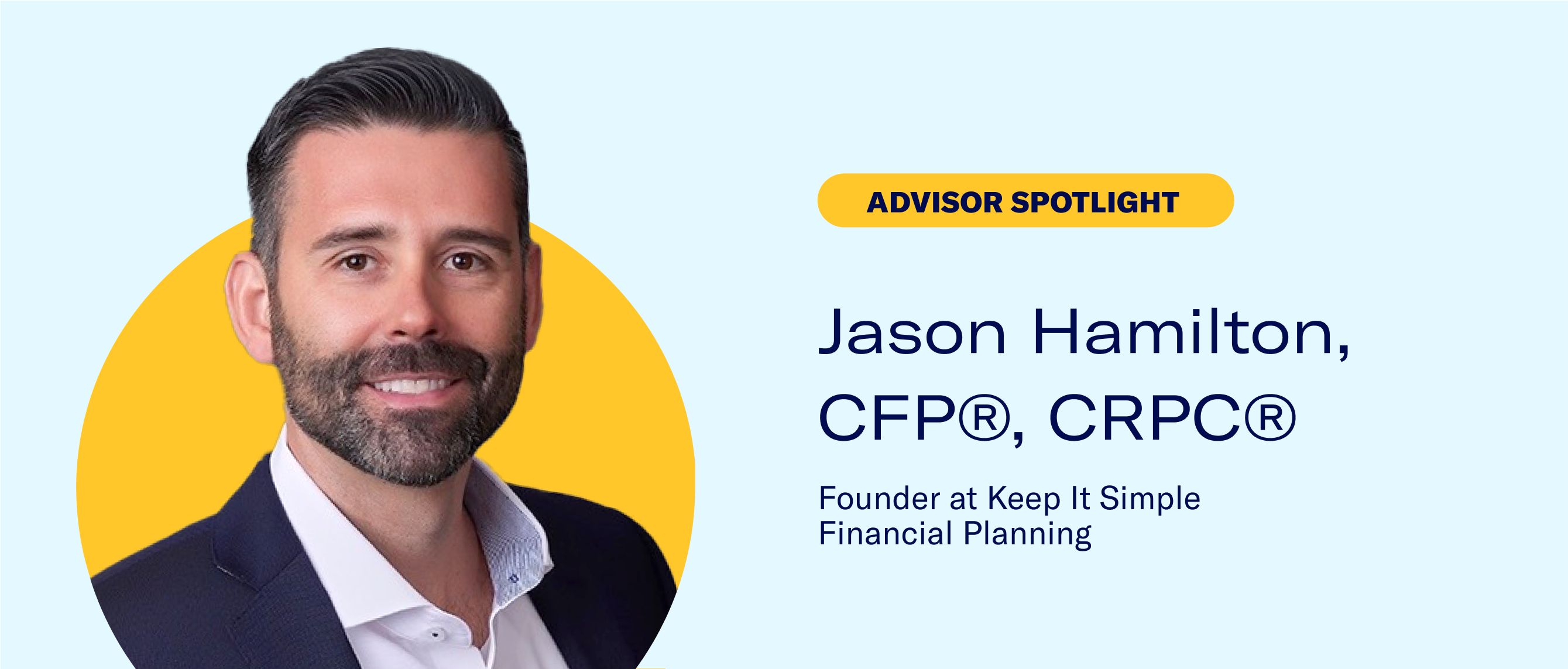
From $0 to $40MM AUM: Jason Hamilton on Improving Client Service with Technology
From $0 to $40MM AUM: Jason Hamilton on Improving Client Service with Technology Jan 23, 2026 10:30:00 AM We sat down with Jason Hamilton to learn about his personal journey to becoming a financial advisor and launching his own practice—and how Betterment's technology has helped him build a $40 million firm. Advisor: Jason Hamilton Jason J. Hamilton, CFP®, CRPC® is a CERTIFIED FINANCIAL PLANNER® and Chartered Retirement Planning Counselor® who helps high-performance professionals and high-net-worth investors create alignment with their abundance so they can live in flow with their wealth and serve their purpose. After coaching clients on their finances for over a decade and over six years as a registered investment advisor, he knows what helps clients go from chaos to serenity with their finances. As a CERTIFIED FINANCIAL PLANNER®, he also brings the technical expertise, education, experience, and ethics requirements investors are looking for to help them achieve their goals, lower their taxes, and optimize their income and investment returns. Jason is the founder of Keep It Simple Financial Planning, a fee-only registered investment advisor, managing over $40 million in assets for his clients. He is also the Head of Family Financial Coaching at his family's nonprofit IDEAL, a community development corporation, located in East Los Angeles. Firm: Keep It Simple Financial Planning Keep It Simple Financial Planning (KISFP) was founded in 2016 to help underserved investors receive technical financial advice in a simple and understandable way. Read more about why we believe “Keep It Simple” is the best philosophy. Why did you decide to become a financial advisor? My story originates just before the 2008 financial crisis. Before this, my family owned a small business: An Italian restaurant in a suburb of San Jose. The restaurant's name was Mio Vicino which means "my neighbor." Prior to the financial crisis, my family hired an advisor to help them with their financial and retirement planning. Unfortunately, instead of comprehensive fiduciary financial advice, my family was sold a myriad of insurance products. I believe with better planning, we would have had a much better response and outcome to the economic situation. Before the end of the crisis, we were forced to close the restaurant due to insufficient financial resources. On the bright side of this journey, I saw what my family went through and became determined to not have the same fate for myself. This led me on my journey of financial self-discovery to learn everything I could about financial planning and wealth management. What started as a Google search for "how do people become wealthy?" became an obsession and now a career. Helping clients get into alignment with their wealth has been rewarding in many ways. For years prior to becoming an advisor, I would read online forums, where I found out about advanced financial planning education to become a CERTIFIED FINANCIAL PLANNER®. At the time, I had no knowledge of the financial planning industry. Since my company offered education reimbursement, I decided to sign up for a course at UCLA extensions. This was the beginning of my journey to become a CFP®. I enjoyed the courses. They filled in the gaps from my prior reading and gave me structure to the process of proper financial planning. It was actually fun! In my search to change careers, I found a group called XY Planning Network that was providing the tools and education to help advisors launch their firms, and the rest is history. I hired coaches and consultants to help me start up and learn the business and the compliance aspects of running a registered investment advisor and, in 2016, I launched Keep It Simple Financial Planning. Over time, I have obtained the Chartered Retirement Planning Counselor® and CERTIFIED FINANCIAL PLANNER® designations. More recently, with the popularity of investing in cryptocurrencies and other digital assets, I completed my Certificate in Blockchain and Digital Assets and became a member of the Digital Assets Council of Financial Professionals. Today, we help clients with flat-fee financial planning advice in nearly 40 states and manage over $40 million in assets under management for our clients. Coming from a lower-middle-class family, we knew how to work but I was never taught HOW to build wealth outside of one day buying a home. Investing was not part of the culture of my family. We all knew how to work hard and sacrifice. But, one thing that I teach now that I didn’t get growing up is how to turn my labor into capital that will work for me. Books also had a significant impact on my journey. Dave Ramsey, Warren Buffet, Suze Orman, and Jack Bogle are a few of the authors from whom I absorbed great insight and knowledge. But the most impactful for me were two books by Thomas J. Stanley: The Millionaire Next Door and The Millionaire Mind. The Millionaire Next Door showed me the path for how to become a first generation millionaire (and that over 80% of millionaires are first generation!). And The Millionaire Mind showed me what it takes to achieve multimillionaire status. Reading these books changed my perspective significantly about what it takes to be successful financially. What is the least understood aspect of your job? The least understood aspect of my job is that many times there is more psychology than technical financial planning in what we do. We are dealing with humans and not machines. Within a number of hours I can tell a client exactly how to optimize their financial situation. The challenge is, what may be optimal financially may not be optimal emotionally. As advisors, the better we are at understanding humans, the more likely our advice is likely to be implemented. What does your firm's current tech stack look like? I am a self-admitted technology addict. While we don't use all of our tools with all clients, there are some great applications for advisors to use when appropriate. We use: Asset Map, RightCapital, Income Conductor, Income Laboratory, Holistiplan, Cash Flow Mapping, Kwanti, AdvicePay, and, of course, Betterment Advisor Solutions. Why did you choose Betterment Advisor Solutions? And how has our technology impacted your business? I have tried multiple custodians since starting my firm but the efficiency, beautiful client portal and app, and the support team I get with Betterment Advisor Solutions is second to none. Because of the digital onboarding and easy digital account transfer process I have been able to scale much faster and serve a more financially diverse client base than I could with a traditional custodian. What is one critical lesson you have learned from your clients? One critical lesson I have learned from my clients is that if you help people get into alignment with their wealth, other parts of their lives will flourish as well. Finances are such an important aspect of living in the United States and, if you can get into flow with your financial wealth interactions, you will experience harmony in other areas of your life typically. How has a remote or hybrid work environment changed how your team works? Our firm has been primarily virtual since our founding over 6 years ago and, since the pandemic, it has tripled in size as many more investors have become comfortable with virtual meetings. In our case, the remote work environment has improved our ability to grow and serve clients. We were ready as more and more clients become comfortable with using virtual communication tools to stay connected to friends and family. Now, it has become the overwhelmingly preferred meeting method and has allowed us to help clients solve the specific challenges they face from nearly anywhere in the nation. What do you think is the biggest opportunity for advisors today? To put themselves out there on social media to discuss and share their expertise. I see so many advisors wasting time and money on paid lead gen services, which if you knew how they worked, are typically a huge waste of money. Maybe not waste but for sure not fully optimized. People in general are desperate for a great advisor that aligns with their personality type. I think if advisors would just put out one educational video per week in their niche, or even general good financial advice, they would never have to struggle for business. If you won the lottery, what would you do with the money? Pay off mom's house and travel a lot. If you could only give one piece of financial advice, what would it be? That if your financial situation is not ideal, DO NOT blame or put any responsibility on anyone outside yourself. If you do not take 100% ownership of your situation you will never be successful. Literally anything you need to know about finances, you can find online in a blog or on YouTube. The challenge is people are typically their own worst enemy when it comes to finances. For this reason, hiring a trusted fiduciary advisor may be the best decision individuals make for themselves. -
![]()
How to set up the Capitect integration
How to set up the Capitect integration Oct 1, 2025 4:18:05 PM Overview Capitect offers modern, holistic performance reporting, flexible client billing, and personalized portfolio rebalancing tailored for today's advisors and their clients. The integration between Betterment Advisor Solutions and Capitect enables advisors to easily include Betterment accounts in reporting, billing, and rebalancing. The information sent to Capitect includes: Account information Positions Transactions Tax lots Enabling the integration You can set up this integration for your firm by taking the following steps: Log in to your advisor dashboard and navigate to Settings > Integrations. Select Capitect from the list and click Connect to Capitect. You will see confirmation that the integration has been enabled. Data will be sent to Capitect within one business day. Once the integration has been enabled, Capitect will reach out directly with next steps.